Crossovers
A deep look at the time-aligned, high-order passive crossovers built for Sunship loudspeakers — component selection, construction methods, and the design philosophy behind them.
The crossovers at the heart of Sunship loudspeakers are engineered with a time-aligned philosophy that prioritizes coherent sound above all else. Each passive network is carefully designed to integrate the horn drivers and woofers so that frequencies arrive at the listener's ear in proper phase relationship, preserving the natural timing of the original recording. The high-order slopes are chosen to minimize interference between drivers in their crossover region, reducing distortion and keeping the frequency response flat across the audible spectrum. This attention to phase and alignment is what separates a truly refined loudspeaker from one that merely plays loud.
Component selection for these crossover networks is taken seriously, with every capacitor, inductor, and resistor chosen for its sonic character as well as its electrical performance. The design team evaluates each part for consistency, stability, and long-term reliability, understanding that a crossover is only as good as its weakest link. Wiring is kept clean and direct, with solid connections that resist degradation over years of use. The result is a network that remains transparent and musical, allowing the character of the TAD drivers to shine through without coloration or smearing of the signal.
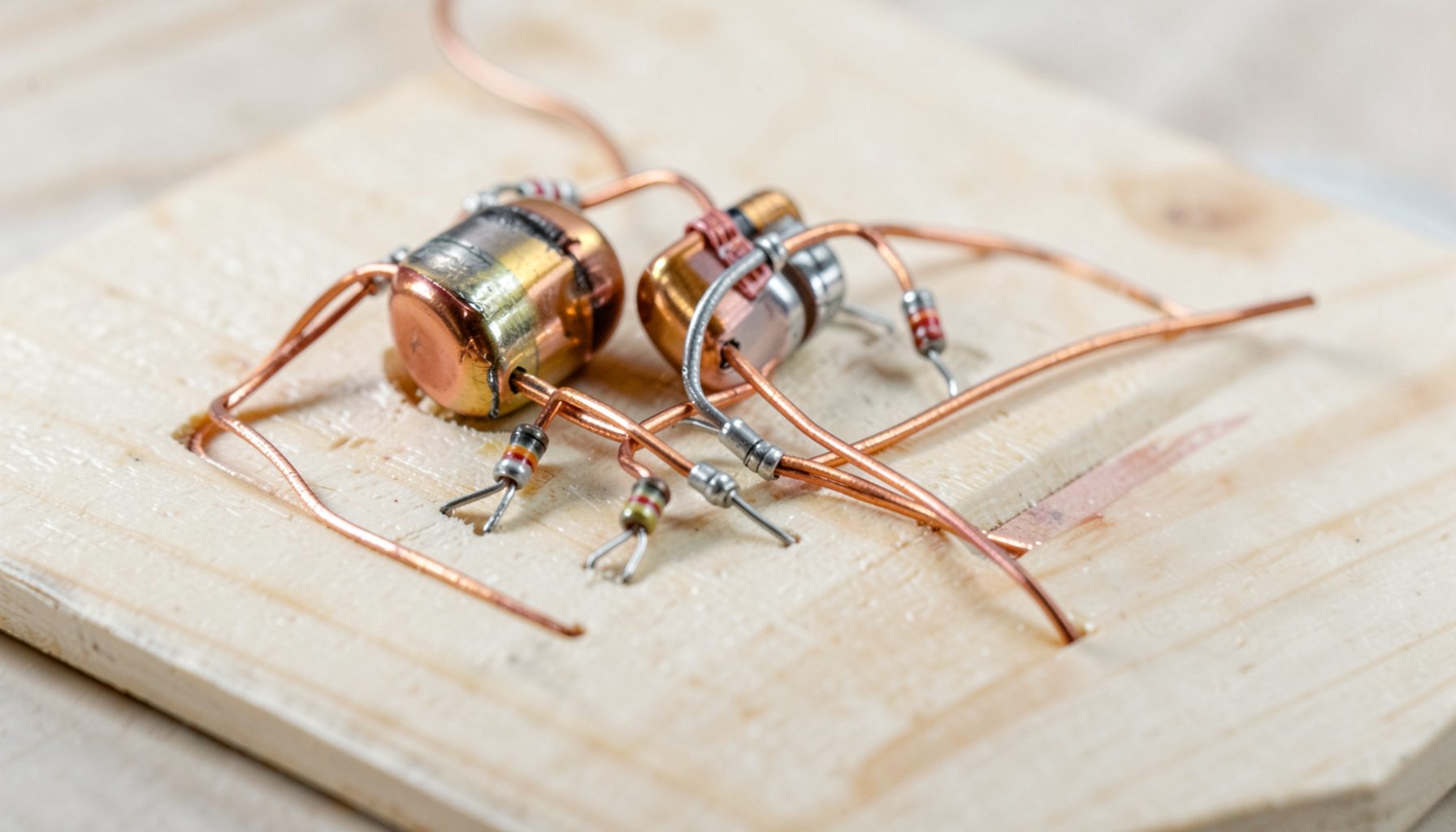
Construction of each crossover reflects the same artisan approach that defines the rest of the Sunship cabinetry. Networks are built by hand, with components carefully mounted and braced inside the cabinet to resist vibration and microphonic effects. The crossover boards are laid out with attention to signal path length and separation, minimizing interaction between stages and keeping noise low. Every unit is tested and measured before installation, with the builder listening critically to confirm that the assembled network performs as designed. This hand-built process is time-consuming, but it ensures consistency and quality that mass production simply cannot match.
The design philosophy behind these crossovers is rooted in the belief that the loudspeaker system should vanish in the listening room, leaving only the music. By keeping the network simple in concept yet meticulous in execution, the crossover allows each driver to operate within its ideal range while blending seamlessly with its neighbors. The result is coherent imaging, natural tonal balance, and a sense of ease that invites long listening sessions. Whether paired with TAD compression drivers and woofers or other high-performance transducers, these crossover designs are built to serve the music first and foremost.
Design Philosophy
The crossover is where a multi-driver loudspeaker lives or dies. For Sunship Audio, the goal was a complex, high-order passive design that delivers flat response to monitoring standards while keeping the transition between the TAD TD-4001 compression driver and TL-1601 woofer completely seamless.
Time alignment is central: the crossover ensures the acoustic centres of both drivers sum coherently at the listening position, preserving transient accuracy and imaging precision across the full bandwidth.
The low-frequency section also controls woofer impedance, making the loudspeaker compatible with low-power tube amplifiers — a deliberate choice that opens the door to a wider range of amplification.
Component Selection
- High-frequency path: Goertz foil inductors — chosen for exceptionally low distortion and clean transient behaviour in the critical upper octaves.
- Low-frequency path: H-core inductors — selected for low DC resistance and the ability to handle substantial bass energy without saturation.
- All capacitors, resistors, and inductors are measured and paired within 0.5% tolerance per channel, ensuring near-identical behaviour between left and right crossovers.
- Every component is individually glued and zip-tied to the board — no floating parts, no mechanical resonance paths.
Construction
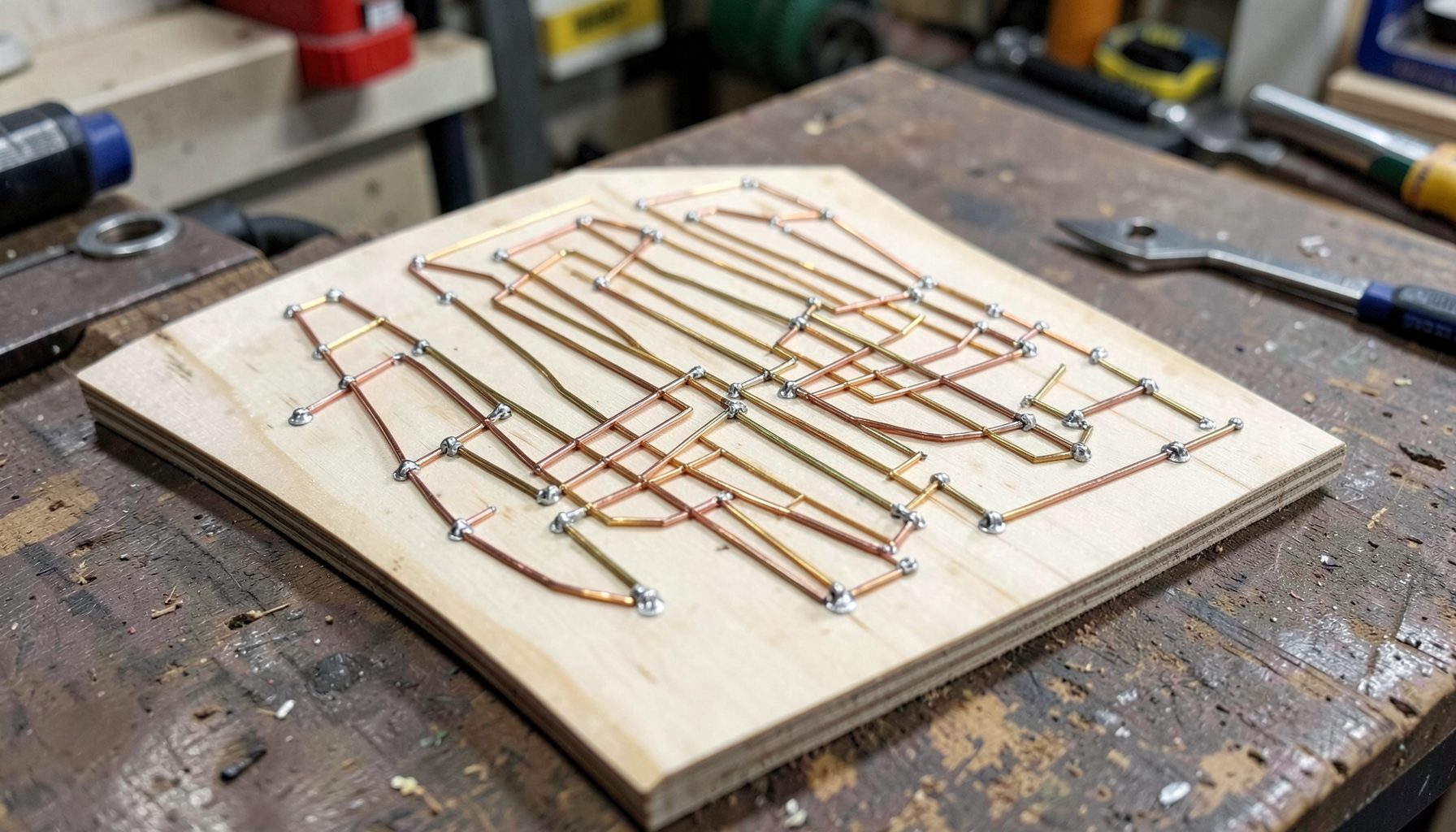
Each crossover is built on a 12 mm plywood board using point-to-point wiring throughout. There are no printed circuit boards — every connection is made directly, minimising the signal path and eliminating trace inductance.
All solder joints use Mundorf Supreme silver/gold solder, selected for its conductivity and long-term mechanical stability. The boards are substantial enough to remain inert under high SPL, and the layout keeps high-current and low-level sections physically separated.
Key Specifications
Topology
High-order passive, time-aligned
HF Inductors
Goertz foil
LF Inductors
H-core, low DCR
Component Matching
Within 0.5% per channel
Board
12 mm plywood, point-to-point
Solder
Mundorf Supreme silver/gold
Availability
The crossovers are designed and voiced specifically for the Sunship loudspeaker system — they are not sold separately. Each pair is built to match its companion horns and cabinets as a complete, integrated design.
For more on the horn design, see the Horns page. Questions are welcome via the FAQs or by email at sunshipaudio at gmail dot com.